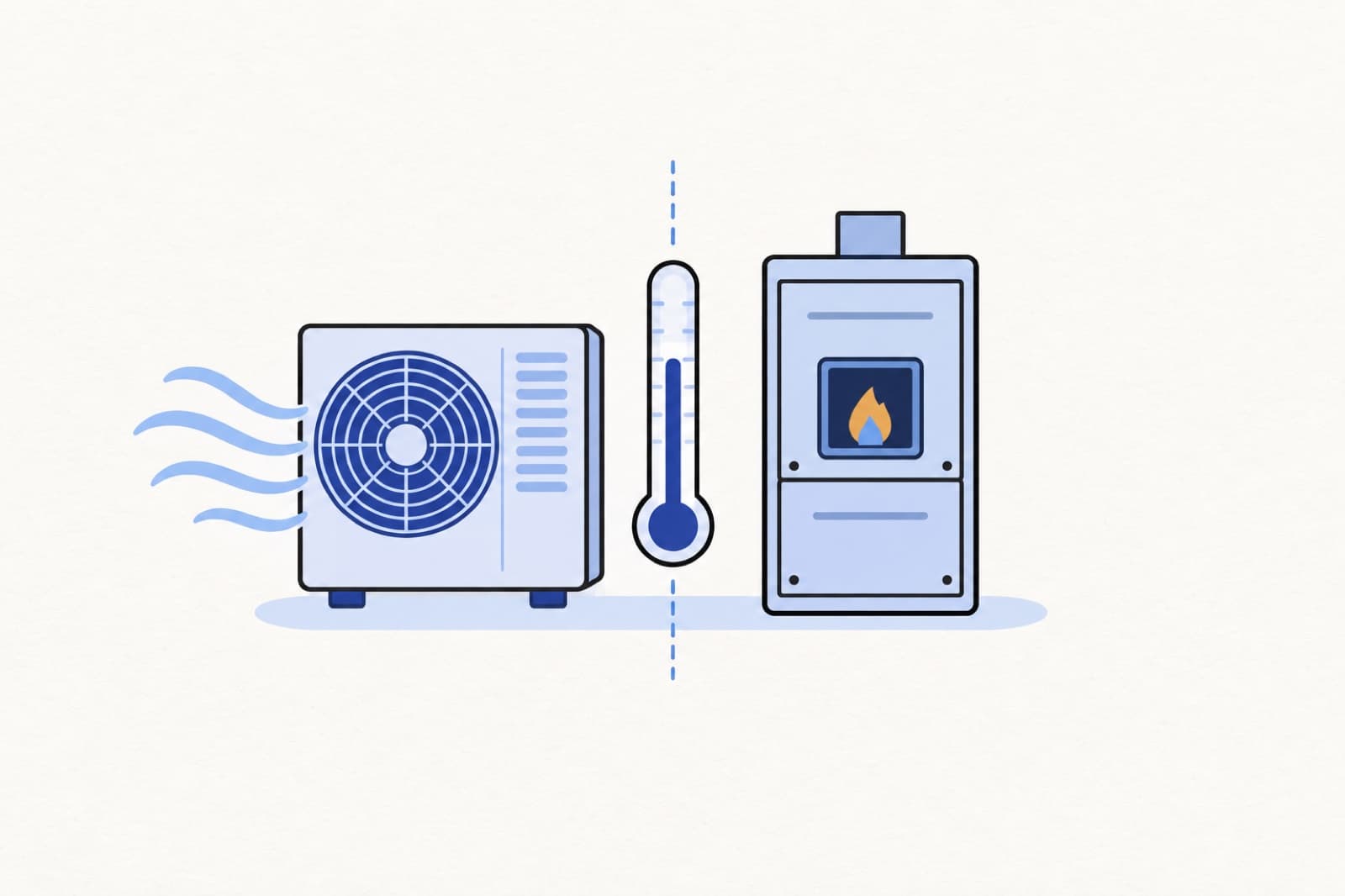
Heat pump vs. gas furnace: which costs less to run?
Compare the cost of a unit of heat: gas price over furnace efficiency, power price over heat pump COP. The break-even formula, a worked example, and when gas still wins.
$9,750
Heat pump replacement
US typical
$6,950–$13,700
Most jobs
P20 to P80
5 min
Checked September 30, 2026
sources listed

It depends on prices. A heat pump costs less to run when electricity in cents per kWh is below gas price per therm × COP ÷ AFUE × 3.412. With gas at $1.50 per therm, a 95% AFUE furnace and a seasonal COP of 3.0, break-even is about 16¢ per kWh. Cheap gas, costly power or deep cold favor gas.
Compare the cost of a unit of heat
Both systems turn purchased energy into heat, at different efficiencies. A gas furnace is rated by AFUE, the share of the fuel’s energy that ends up as heat in the house. The federal minimum for most new gas furnaces is 80% AFUE, and condensing furnaces are rated 90% or higher. DOE has adopted a 95% minimum for most gas furnaces made from late 2028, but that rule is being challenged in court.
A heat pump moves heat instead of making it, so it can deliver more heat than the electricity it uses. That ratio is the coefficient of performance, or COP. A COP of 3 means three units of heat for each unit of electricity. COP falls as the outdoor temperature drops. Dividing the seasonal rating, HSPF2, by 3.412 gives a rough seasonal COP for the test climate: the federal minimum of 7.5 HSPF2 works out to about 2.2.
The break-even formula
One therm of gas holds 100,000 Btu and one kWh of electricity holds 3,412 Btu, so a therm carries the energy of about 29.3 kWh. Put your prices and your equipment’s efficiency into this:
Worked example: gas at $1.50 per therm, a 95% AFUE furnace, and a heat pump averaging a COP of 3.0. Break-even is 1.50 × 3.0 ÷ 0.95 × 3.412, or about 16.2¢ per kWh. Here is what one million Btu of delivered heat costs at $1.50 per therm and 16¢ per kWh:
| Equipment | Cost per million Btu of heat |
|---|---|
| Gas furnace, 95% AFUE | About $15.80 |
| Gas furnace, 80% AFUE | About $18.75 |
| Heat pump, seasonal COP 3.0 | About $15.60 |
| Heat pump, seasonal COP 2.5 | About $18.75 |
| Heat pump on a 5°F day, COP 1.75 | About $26.80 |
| Electric resistance heat, COP 1.0 | About $46.90 |
These are example prices, not averages. Use your own bills: take the price per therm or per kWh including delivery charges, but leave out fixed monthly fees. If your gas bill is in CCF, one CCF is about 1.04 therms. If a heat pump lets you close the gas account, that fixed charge goes away too; if you keep gas for a water heater or range, it stays.
Cold climates and cold-climate heat pumps
In cold weather, a heat pump’s COP and its heating capacity both drop. ENERGY STAR’s cold-climate label requires a COP of at least 1.75 at 5°F, and at least 70% of the unit’s 47°F heating capacity still available at 5°F. Even at a COP of 1.75, a heat pump uses far less electricity than resistance heat.
When the heat pump can’t keep up, backup heat takes over, usually electric resistance strips at a COP of 1. How often that happens depends on your climate and on whether the system was sized for the heating load, not just the cooling load. Ask the contractor down to what outdoor temperature the heat pump can carry the house alone, and what the backup is.
Dual fuel
A dual-fuel system pairs a heat pump with a gas furnace. The heat pump runs in mild weather and the furnace takes over below a set outdoor temperature. The formula tells you where to set it. At the example prices above, the heat pump is cheaper whenever its COP is above about 3.0, and the furnace is cheaper below that. The manufacturer’s performance data shows the outdoor temperature where the COP crosses that line.
Dual fuel is a common path when the air conditioner fails but the furnace is young: a heat pump replaces the AC, and the furnace stays for the coldest days.
Installed cost
Compare the right things. A heat pump replaces the air conditioner as well as most of the furnace’s work, so weigh it against an AC plus a furnace, not a furnace alone. If your AC is due for replacement anyway, the real question is the extra cost of a heat pump over a new AC. Electrical work adds cost if the home needs a larger circuit or panel.
Incentives have narrowed. The federal 25C tax credit ended for equipment placed in service after December 31, 2025. Since May 29, 2026, DOE guidance for state HEEHR rebates no longer funds replacing gas or oil equipment with a heat pump in existing homes. Utility rebates vary by area.
When gas still wins
- Your gas is cheap and your electricity is expensive, so the break-even price is below what you pay per kWh.
- You live somewhere very cold and the heat pump would lean on resistance backup for long stretches.
- You will keep gas for other appliances, so the fixed gas charge stays either way.
- Your furnace is young and working and only the AC needs replacing. Adding a heat pump to it (dual fuel) may be the middle path.
Questions
Is a heat pump cheaper to run than a gas furnace? Only if your electricity price is below the break-even for your gas price and equipment. Plug the prices from your bills into the formula above to find out.
What COP does a heat pump get in winter? It depends on the model and the temperature, and it falls as it gets colder. ENERGY STAR cold-climate models must reach a COP of at least 1.75 at 5°F.
What is a dual-fuel system? A heat pump paired with a gas furnace. The heat pump heats in mild weather, and the furnace takes over when it is colder or when gas is cheaper per unit of heat.
Are there federal incentives for switching from gas to a heat pump in 2026? The 25C tax credit ended for equipment placed in service after 2025. Since May 29, 2026, HEEHR rebates no longer fund replacing gas equipment with a heat pump in existing homes. Check your utility for its own rebates.
Sources
- ENERGY STAR: Heat pump specification v6.2 (cold-climate criteria) — https://www.energystar.gov/sites/default/files/2026-02/HP%20Version%206.2%20Specification%20Revised%20February%202026.pdf
- DOE: Purchasing energy-efficient residential furnaces — https://www.energy.gov/cmei/femp/purchasing-energy-efficient-residential-furnaces
- DOE: Consumer furnaces standards — https://www.energy.gov/cmei/buildings/consumer-furnaces
- DOE: Residential furnace standard announcement (95% AFUE, 2028) — https://www.energy.gov/articles/doe-finalizes-energy-efficiency-standards-residential-furnaces-save-americans-15-billion
- DOE: 2023 standards for central ACs and heat pumps — https://www1.eere.energy.gov/buildings/appliance_standards/pdfs/2023_CAC_Standards_FAQ_10-5-2022_Final.pdf
- EIA: Natural gas heat content and therm conversion — https://www.eia.gov/tools/faqs/faq.php?id=45&t=8
- DOE: Home Energy Rebates Program Notice 26-2 (HEEHR) — https://www.energy.gov/documents/program-notice-26-2
- IRS: Energy Efficient Home Improvement Credit — https://www.irs.gov/credits-deductions/energy-efficient-home-improvement-credit
Second opinion
Get one fair quote from a licensed local pro
Tell us the job and when suits you. We confirm by phone or text, then pass your request to one licensed contractor who covers your ZIP. Nobody else gets your number.
- We confirm the job before anyone calls you
- One contractor, never a bidding list
- License checked with the state
- Free for homeowners