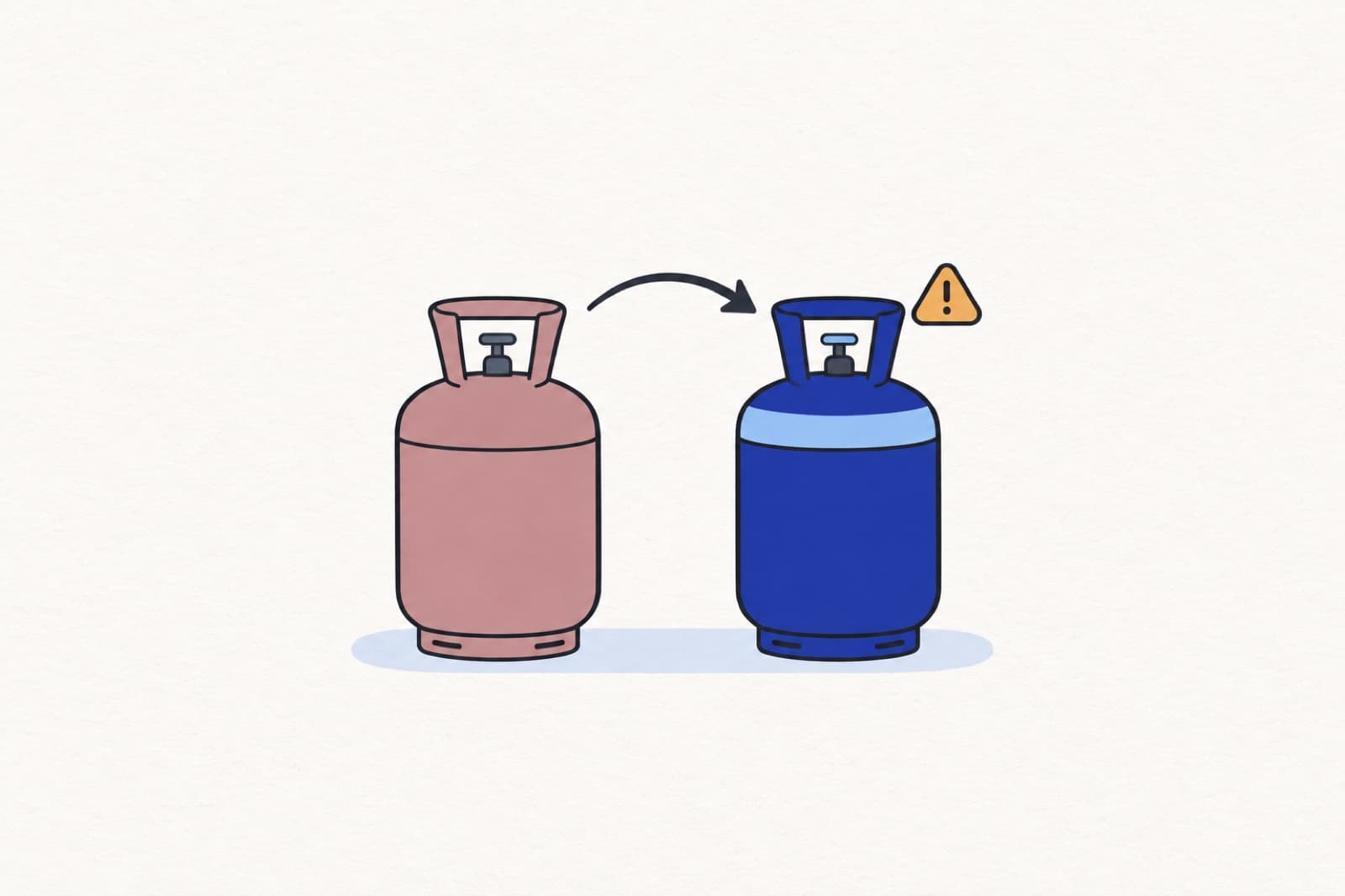
R-410A to R-454B: what the refrigerant change means
New home AC and heat pump systems made since 2025 use lower-GWP refrigerants like R-454B or R-32. Pre-2025 R-410A stock can still be installed, and old systems repaired.
$7,000
AC replacement
US typical
$4,650–$10,450
Most jobs
P20 to P80
4 min
Checked September 30, 2026
sources listed

Under EPA’s Technology Transitions rule, new home AC and heat pump systems made or imported since January 1, 2025 must use refrigerant with a GWP of 700 or less, such as R-454B or R-32. A May 2026 EPA rule removed the 2026 installation deadline for R-410A systems built entirely from pre-2025 components. Existing systems can still be repaired.
What the rule says
The American Innovation and Manufacturing (AIM) Act of 2020 directs EPA to phase down hydrofluorocarbons (HFCs) and to restrict their use sector by sector. EPA’s 2023 Technology Transitions rule set a global warming potential (GWP) limit of 700 for new residential and light commercial air conditioning and heat pump systems, starting with systems manufactured or imported on January 1, 2025.
R-410A, the standard refrigerant in home systems before this change, has a GWP of 2,090, so it can’t be used in newly made systems. EPA lists R-454B (GWP 470) and R-32 (GWP 675) as acceptable, with conditions, in new home systems.
| Date | What changed |
|---|---|
| January 1, 2020 | No new R-22 may be produced or imported. Servicing relies on recovered, reclaimed or stockpiled R-22. |
| January 1, 2024 | HFC production and import allowances drop to 60% of the baseline, through 2028. |
| January 1, 2025 | New home AC and heat pump systems made or imported must use refrigerant with a GWP of 700 or less. |
| January 1, 2026 | The original deadline to install R-410A split systems built from pre-2025 components. |
| July 27, 2026 | EPA’s May 2026 rule takes effect, removing that deadline for pre-2025 equipment. |
| January 1, 2029 | HFC allowances drop to 30% of the baseline, then 20% in 2034 and 15% from 2036. |
What sell-through means now
The 2023 rule let installers use up pre-2025 R-410A split-system components until the end of 2025. In May 2026, EPA finalized a rule that removes that end date. A system can now be installed with no deadline, as long as all of its specified components were manufactured or imported before January 1, 2025. Once that inventory is gone, it is gone. A new R-410A system that includes any main component made after 2024 does not qualify.
So an R-410A quote in 2026 can be legal, but ask three things: the manufacture dates of each main component, whether the warranty starts at installation, and how the contractor expects to service it as R-410A supply shrinks.
Repairs on existing R-410A systems
The rule does not restrict using or repairing systems already installed. EPA says an existing system may be serviced and repaired throughout its useful life, including replacing a major component such as a condensing unit or compressor. Components used to repair existing systems are not subject to the restrictions.
Supply is the long-term issue. HFC allowances step down from 60% of the baseline today to 30% in 2029 and 15% from 2036, and EPA notes that the availability of HFCs and components may lessen over time. A leaking system is better fixed than refilled every season. And R-454B or R-32 is not a drop-in: EPA’s approval of them for home air conditioning covers new equipment designed for them, so an R-410A system needs R-410A.
A2L safety
R-454B and R-32 are classed A2L, meaning lower flammability. EPA allows them in new home systems only under use conditions that require the equipment to meet the UL 60335-2-40 safety standard, which limits refrigerant charge and requires flammability warning labels. Depending on the system, safety standards can also call for a refrigerant leak detector.
For homeowners, day-to-day use doesn’t change. Installation and service should be done by technicians trained on A2L equipment who hold EPA Section 608 certification, and installers should follow the manufacturer’s instructions for line sets, brazing and charge.
R-22 systems
R-22 was phased out earlier, under the ozone rules. Since 2020, no new R-22 has been produced or imported, and EPA does not require owners to replace working equipment. Repairs that need refrigerant depend on recovered and stockpiled supply. EPA warns against filling an R-22 system with propane or other unapproved refrigerants, which are a fire hazard.
What it means for cost
A full replacement in 2026 usually means new A2L equipment, indoor and outdoor, designed together. Partial replacements are more limited than before. If a quote replaces only the outdoor unit, ask whether it has an AHRI-certified match with your existing indoor coil; if not, the quote should include a new coil. For an older R-410A system facing a major repair, weigh the repair against the fact that the refrigerant it needs is being phased down.
Questions
Is it illegal to install an R-410A system in 2026? Not if every specified component was manufactured or imported before January 1, 2025. EPA removed the January 1, 2026 installation deadline for that inventory in a rule effective July 27, 2026. Systems built with newer components must use a refrigerant with a GWP of 700 or less.
Can my R-410A system still be repaired? Yes. EPA allows existing systems to be repaired for their whole useful life, including a new compressor or condensing unit. Refrigerant supply will tighten as the HFC phasedown continues.
Can R-454B be added to an R-410A system? No. EPA’s approval of R-454B and R-32 for home air conditioning covers new equipment designed for them. Use only the refrigerant named on your system’s data plate.
Are A2L refrigerants safe in a home? They are mildly flammable, which is why EPA requires equipment to meet the UL 60335-2-40 safety standard, with charge limits and warning labels. Installation and service should be done by trained, EPA-certified technicians.
Sources
- EPA: Technology Transitions HFC restrictions by sector — https://www.epa.gov/hfcs/technology-transitions-hfc-restrictions-sector
- EPA: May 2026 Technology Transitions final rule fact sheet — https://www.epa.gov/system/files/documents/2026-05/fact-sheet-san-12166-technology-transitions-frm.pdf
- Federal Register: Reconsideration of Technology Transitions requirements (May 26, 2026) — https://www.federalregister.gov/documents/2026/05/26/2026-10387/phasedown-of-hydrofluorocarbons-reconsideration-of-certain-regulatory-requirements-promulgated-under
- EPA: Frequent questions on the phasedown of HFCs — https://www.epa.gov/hfcs/frequent-questions-phasedown-hydrofluorocarbons
- EPA SNAP: Substitutes in residential and light commercial AC and heat pumps — https://www.epa.gov/snap/substitutes-residential-and-light-commercial-air-conditioning-and-heat-pumps
- EPA: Residential air conditioning and the phaseout of HCFC-22 — https://www.epa.gov/sites/default/files/2020-03/documents/residential_air_conditioning_and_the_phaseout_of_hcfc-22_what_you_need_to_know_final_508.pdf
- EPA: Purchasing and repairing home air conditioners and heat pumps — https://www.epa.gov/ods-phaseout/purchasing-and-repairing-home-air-conditioners-or-heat-pumps
- EPA: Section 608 technician certification requirements — https://www.epa.gov/section608/section-608-technician-certification-requirements
Second opinion
Get one fair quote from a licensed local pro
Tell us the job and when suits you. We confirm by phone or text, then pass your request to one licensed contractor who covers your ZIP. Nobody else gets your number.
- We confirm the job before anyone calls you
- One contractor, never a bidding list
- License checked with the state
- Free for homeowners