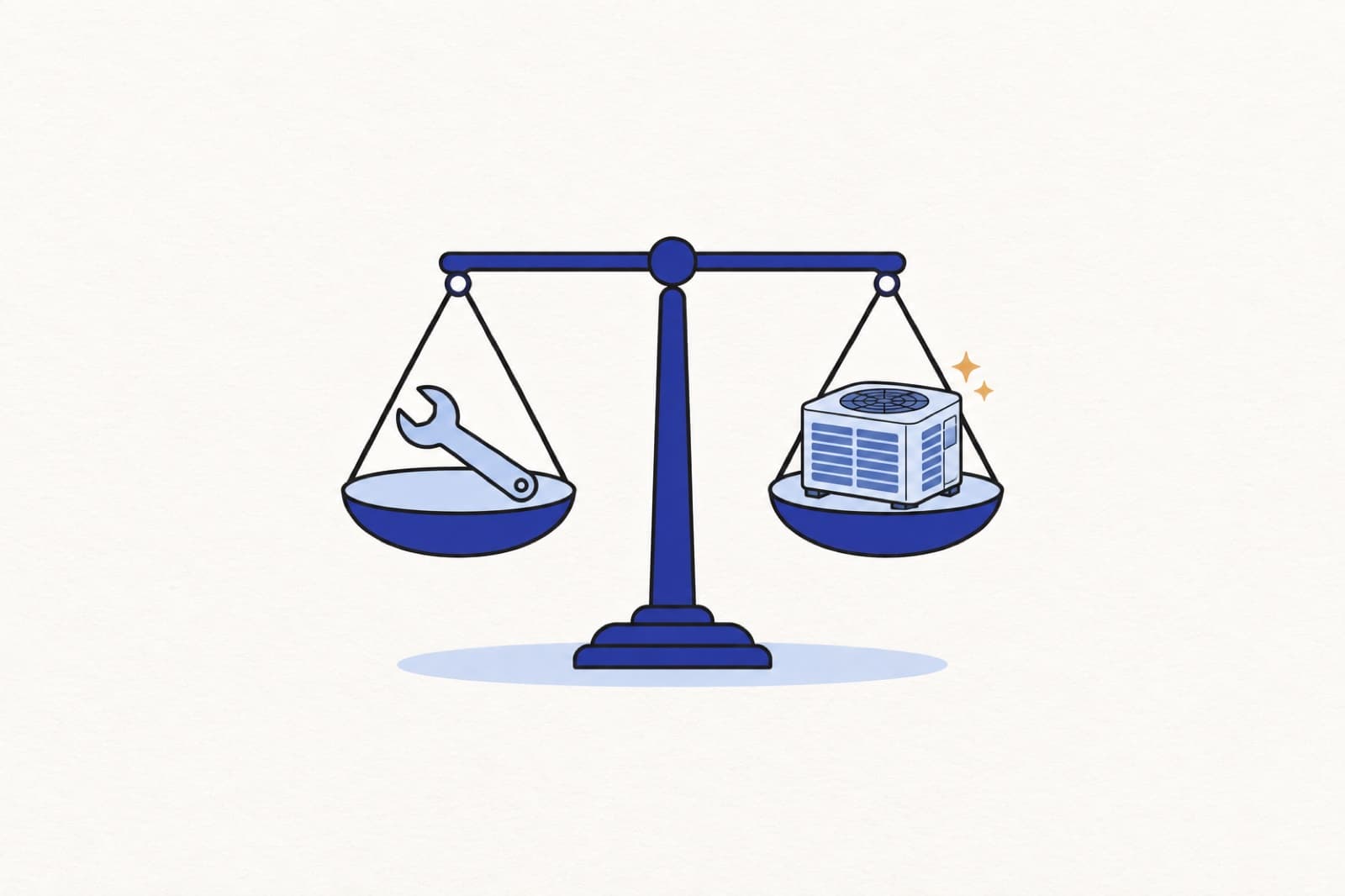
Should you repair or replace your AC?
Repair usually wins on a younger system with one failed part. Replace when the compressor or coil fails on an older unit, it runs on R-22, or repairs keep stacking up.
$7,000
AC replacement
US typical
$4,650–$10,450
Most jobs
P20 to P80
4 min
Checked September 30, 2026
sources listed

Repair when the system is under about 10 years old and one common part failed, such as a capacitor, contactor or fan motor. Get replacement quotes when it is older, uses R-22, or needs a compressor or coil. A trade rule of thumb: if age in years times the repair cost exceeds $5,000, compare replacement first.
Start with the age
Age is the first number to know. The serial number on the outdoor unit’s data plate usually encodes the year, and often the week, it was made. The format differs by manufacturer.
ENERGY STAR suggests having equipment evaluated by a professional once it is more than 10 years old or no longer keeps the house comfortable. DOE’s consumer guide says a system over 15 years old is a candidate for replacement to cut energy bills. Neither means a working system must go. They mark the point where the question is worth asking.
The $5,000 rule and its limits
A common rule of thumb in the trade: multiply the system’s age in years by the repair cost. If the result is over $5,000, get a replacement quote before you approve the repair. For example, a 12-year-old system facing a $500 repair scores 6,000; a 5-year-old system with the same repair scores 2,500.
It is a quick filter, not a standard. It leaves out several things:
- Warranty. A failed part still under the parts warranty changes the math.
- Efficiency. A very old, low-efficiency system costs more to run every month, which the rule ignores.
- Refrigerant. R-22 systems depend on a shrinking supply. R-410A systems are fully repairable, but that refrigerant is being phased down too.
- The rest of the system. A new part on a system with a corroded coil or a failing blower may be the first of several repairs.
- Comfort. A system that is the wrong size won’t get better with a repair.
Failures that change the answer
| Failure | Usual direction |
|---|---|
| Capacitor or contactor | Repair. Small, common parts on a system of any age. |
| Condenser fan motor or blower motor | Usually repair, unless the system is old and other problems are stacking up. |
| Refrigerant leak | Find and fix the leak. Topping up every season means the leak is still there. |
| Evaporator coil | Weigh age and refrigerant. On an older system, a coil is a large share of what a new system costs. |
| Compressor | On an older system out of warranty, replacement is often the better value. |
Part swaps on older split systems have a catch. Efficiency ratings belong to certified combinations of outdoor unit and indoor coil. A new outdoor unit on an old coil may not match any certified combination, so it may not deliver its rated efficiency or capacity.
R-22 systems
Older systems may use R-22, also called HCFC-22; the data plate says which refrigerant yours uses. Since January 1, 2020, no new R-22 may be produced or imported in the US. Existing systems can still be serviced with recovered, reclaimed or previously produced R-22, and EPA does not require you to replace the equipment. But any repair that involves refrigerant depends on that limited supply. If an R-22 system needs a compressor, a coil or a major leak repair, that is usually the time to get replacement quotes.
Don’t let anyone top off an R-22 system with a refrigerant that isn’t approved for it. EPA warns that propane and other unapproved refrigerants are a fire and explosion hazard in home air conditioners.
What a newer system saves
Minimum efficiency has risen over time. The national minimum for central air conditioners was SEER 10 in 1992 and SEER 13 from 2006. Since 2023, new split systems must reach 13.4 SEER2 in the North and 14.3 SEER2 in the Southeast and Southwest for most home sizes. DOE’s own example: moving from a SEER 10 system to a SEER 15 one can cut a $100 monthly cooling bill by up to $35.
Savings depend on how much you cool; a long, hot season adds them up faster. Installation matters as much as the rating: ENERGY STAR says improper installation can cut a system’s efficiency by up to 30%.
When repair is the right call
- The system is under about 10 years old and the failure is a single, common part.
- The repair passes the $5,000 test and the rest of the system is in good shape.
- The part is under warranty and only labor is due.
- You plan to move soon and a new system wouldn’t pay back.
- You need time to collect several replacement quotes instead of buying in an emergency.
Questions
How do I find out how old my AC is? Read the serial number on the data plate of the outdoor unit. Most manufacturers encode the year of manufacture in it, but each uses its own format.
Is it worth fixing a 15-year-old AC? Small repairs can be. By the $5,000 rule of thumb, any repair over about $333 on a 15-year-old system is worth comparing with replacement, and a failed compressor or coil usually tips it.
Can I still repair an R-410A system? Yes. EPA rules allow existing systems to be repaired for their whole useful life, including replacing a compressor or condensing unit. R-410A supply is being phased down, so availability may tighten over time.
Do I have to replace my R-22 air conditioner? No. EPA does not require it. But no new R-22 has been produced or imported since 2020, so repairs that need refrigerant rely on recycled or stockpiled supply.
Sources
- ENERGY STAR: Heat and cool efficiently — https://www.energystar.gov/saveathome/heating-cooling
- DOE: Consumer Guide to Home Heating and Cooling — https://www.energy.gov/sites/default/files/2021-08/ES-HomeHeatingandCooling_081221.pdf
- EPA: Residential air conditioning and the phaseout of HCFC-22 — https://www.epa.gov/sites/default/files/2020-03/documents/residential_air_conditioning_and_the_phaseout_of_hcfc-22_what_you_need_to_know_final_508.pdf
- EPA: Purchasing and repairing home air conditioners and heat pumps — https://www.epa.gov/ods-phaseout/purchasing-and-repairing-home-air-conditioners-or-heat-pumps
- EPA: Frequent questions on the phasedown of HFCs — https://www.epa.gov/hfcs/frequent-questions-phasedown-hydrofluorocarbons
- DOE: 2023 central air conditioner standards guidance — https://www1.eere.energy.gov/buildings/appliance_standards/pdfs/2023_CAC_Standards_FAQ_10-5-2022_Final.pdf
Second opinion
Get one fair quote from a licensed local pro
Tell us the job and when suits you. We confirm by phone or text, then pass your request to one licensed contractor who covers your ZIP. Nobody else gets your number.
- We confirm the job before anyone calls you
- One contractor, never a bidding list
- License checked with the state
- Free for homeowners